

Table of Contents
- Why the ABA Ethics Guidelines for Remote Legal Work Matter Now
- ABA Formal Opinion 498: What It Actually Requires
- Remote Legal Work Cybersecurity Best Practices
- Supervision of Remote Legal Staff: Your Non-Delegable Duty
- Jurisdictional Boundaries and Cross-Border Remote Practice
- Insurance and Malpractice Implications of Remote Work
- Conclusion
- Frequently Asked Questions
Last Updated: September 24, 2026
Why the ABA Ethics Guidelines for Remote Legal Work Matter Now
Remote legal work is standard at firms of every size, but the ABA ethics guidelines for remote legal work were never a single rulebook. They are scattered across the Model Rules of Professional Conduct, formal opinions, and state bar guidance, so attorneys working from home must assemble the compliance picture themselves.
This guide pulls those obligations into one reference: what Formal Opinion 498 requires, the cybersecurity standards that satisfy confidentiality, how to supervise remote staff, and the insurance questions most firms never ask until a claim arrives.
Here’s what most summaries get wrong: the ABA does not regulate you directly. ABA Center for Professional Responsibility publishes the Model Rules and formal opinions as guidance, but enforcement runs through your state bar and your state’s version of those rules.
Treating an ABA formal opinion as optional guidance is a common and costly mistake. Most state bars have adopted some version of the Model Rules, and a disciplinary complaint will be evaluated against your state’s rules, not the ABA’s recommendations.
ABA Formal Opinion 498: What It Actually Requires
ABA Formal Opinion 498 addresses virtual practice directly. Issued in 2021, it confirms that lawyers may practice remotely, including from a virtual office, provided they protect confidentiality, supervise staff, and stay competent with their technology.
- Confidentiality. Client information must remain protected regardless of where it is accessed or stored.
- Competence. You must understand the technology you rely on well enough to identify its risks.
- Supervision. Lawyers remain responsible for the conduct of non-lawyer assistants, wherever those assistants sit.
Remote Legal Work Cybersecurity Best Practices
Remote legal work cybersecurity best practices come down to one principle: assume the network is hostile and the device will eventually be lost. Build protocols around that assumption and most confidentiality failures become preventable.
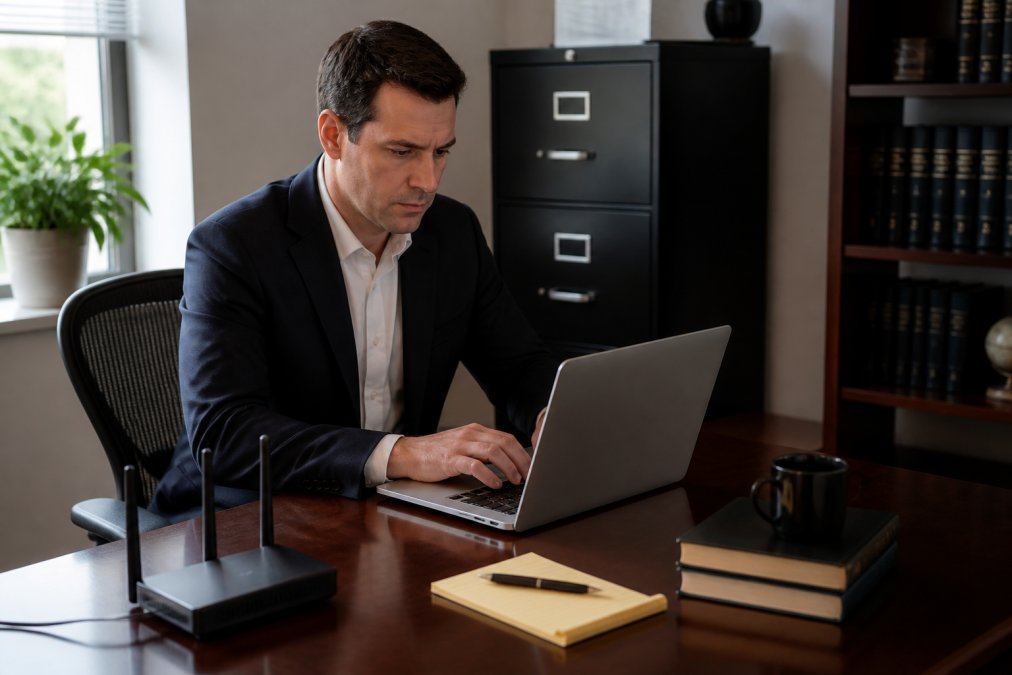
Hardware and Software Checklist
Work through this list before allowing any attorney or assistant to access client files remotely:
- Full-disk encryption enabled on every laptop and phone (FileVault on macOS, BitLocker on Windows, and device encryption on iOS and Android)
- Firm-managed password manager with unique credentials per system
- Multi-factor authentication on email, case management, and cloud storage, phishing-resistant methods such as hardware security keys or passkeys where available
- Business-grade VPN required for any public or shared network
- Automatic security patching enabled, with a monthly verification step
- Locked physical storage for any printed client material
- Remote wipe capability configured on all mobile devices
- Written incident response plan naming who to notify and when
Matching Controls to the Standard They Satisfy
The checklist above is only useful if you can explain why each item exists. Map controls to your firm’s framework:
- Identify and Protect. Asset inventory of every device that touches client data, plus encryption and access controls. This layer satisfies the confidentiality duty under Model Rule 1.6.
- Detect. Logging on case management and cloud storage, with alerts for anomalous sign-ins. Most small firms skip this and cannot answer “when did the breach start?”
- Respond and Recover. The written incident response plan, tested at least annually. A plan never rehearsed is a document, not a capability.
- Govern. A named person accountable for the policy, and a review cadence. Without an owner, the policy decays within two quarters.
Encryption protects data at rest, but it does nothing for a misdirected email. Set a firm rule that client documents never leave the case management system as email attachments. Share through a secure portal link instead, and the most common breach vector disappears.
The Trade-Offs Nobody Documents
Every control has a cost, and the ethical analysis requires you to name it:
- Cloud versus on-premises. Cloud providers typically offer stronger physical and network security than a small firm can build, but they introduce vendor risk and data residency questions. Document which provider, which region, and what happens if the provider is breached.
- Convenience versus control. Allowing personal devices (BYOD) saves hardware cost but expands the attack surface and complicates remote wipe. If you permit BYOD, require device enrollment in mobile device management and written acknowledgment that firm data may be wiped.
- Speed versus verification. Multi-factor authentication adds a step to every login. Firms that disable it for convenience are the ones that appear in breach notifications.
A written policy that no one follows is worse than no policy at all. In a disciplinary review, the existence of a policy you ignored is evidence of knowledge, not of diligence. Audit compliance quarterly and document the audit.
::: Rigorous oversight of these internal protocols serves as the foundation for broader data security compliance, which remains essential when managing sensitive client information across distributed digital environments.
Supervision of Remote Legal Staff: Your Non-Delegable Duty
Supervision of remote legal staff is the obligation firms most often underestimate. You can delegate the work, not the responsibility.
The Mentorship Gap Remote Work Creates
A junior associate in a traditional office absorbs judgment by proximity: overhearing a partner handle a difficult client call, watching a deposition get prepped, asking a two-minute question that would never justify a meeting. Remote work removes that ambient learning. A firm that fails to train associates adequately produces lawyers who will eventually practice unsupervised and make the mistakes training was supposed to prevent.
Practical Supervision of a Distributed Team
Firms that get remote supervision right tend to share these habits:
- Document who has access to which matters, and review that list quarterly.
- Require assistants to flag any task that edges toward legal judgment rather than completing it independently.
- Build a written escalation path for client questions that require attorney input.
- Audit work product on a schedule, not only when something goes wrong.
- Pair every junior lawyer and paralegal with a named supervising attorney who owns their development, not just their output.
- Schedule recurring one-on-one reviews that include a training component, not only a status update.
Rebuilding Apprenticeship Remotely
A few mechanisms that substitute for the hallway:
- Shadowing rotations. Have junior staff observe client calls and depositions, with a debrief afterward. The debrief is where the learning happens.
- Redline reviews. When a senior lawyer edits a junior’s work, walk through the changes live rather than returning a clean document. The reasoning behind an edit is the training.
- Structured question channels. A standing channel where junior staff can ask questions without the friction of scheduling a meeting. The absence of a place to ask produces silent errors.
- Documented competency milestones. Define what a junior lawyer should do independently at six, twelve, and twenty-four months, and review progress against those milestones.
None of this is required by a single rule. All of it is what Rule 5.1’s “reasonable assurance” looks like in a distributed office.
The Unauthorized Practice of Law Risk
Supervision is not a compliance checkbox. It is the mechanism by which a firm transfers judgment to the next generation. If your remote structure supervises output but never trains judgment, you are meeting Rule 5.3 and failing Rule 5.1, and the failure will not surface until a former associate practices unsupervised.
This is where the right staffing infrastructure earns its keep. Bluebook Helpers builds supervision and training into the arrangement itself: staff are trained on firm-specific software, performance and attendance are monitored continuously, and if an assigned staff member is not working out, the firm can request a replacement at no extra cost rather than restarting recruitment. For a solo practitioner who cannot audit every task personally, that structure is the difference between delegation and exposure.
Jurisdictional Boundaries and Cross-Border Remote Practice
Before any attorney or staff member works from outside the state where the firm is admitted, document the analysis: which jurisdiction’s rules apply, whether temporary practice is permitted there, and how client data will be handled. Undocumented assumptions are what turn a routine arrangement into a disciplinary matter.
Multi-jurisdictional practice deserves a standing review. ABA resources on multijurisdictional practice outline the safe harbor provisions under Model Rule 5.5, but state adoption of those provisions varies widely. Verify your specific states rather than assuming uniformity.
Insurance and Malpractice Implications of Remote Work
Malpractice coverage for remote work is not automatic, and this gap catches firms off guard. Many professional liability policies predate distributed work, and their terms may not clearly address remote staff, home offices, or data breaches.
Three questions belong on your next renewal conversation:
- Does the policy cover claims arising from work performed by remote non-lawyer staff?
- Is there separate cyber liability coverage, or is a data breach excluded from the professional liability policy?
- Does the policy address work performed from another state or country?
Conclusion
The ABA ethics guidelines for remote legal work are not complicated in principle: protect client information, stay competent with your tools, supervise the people who touch your files, and know where you are permitted to practice. Execution is the hard part, especially when your support staff works somewhere you have never visited.
Frequently Asked Questions
What are the ABA ethical requirements for remote legal work?
The ABA requires lawyers to maintain confidentiality, competence, and supervision when working remotely. Formal Opinion 498 clarifies that lawyers must use reasonable efforts to prevent unauthorized access to client information, including securing devices and networks. You must also supervise remote staff and ensure they understand their ethical obligations. State bar associations may impose additional rules, so check your jurisdiction’s guidance.
How do law firms maintain attorney-client privilege in a remote environment?
Maintaining privilege remotely requires using encrypted communication tools, avoiding public Wi-Fi for client matters, and storing files on secure cloud platforms with access controls. Formal Opinion 498 emphasizes that lawyers should take reasonable steps to protect client data. Train remote staff on confidentiality protocols and document your security measures. A written remote work policy helps demonstrate compliance if privilege is challenged.
What are the cybersecurity obligations for remote legal staff?
Remote legal staff must follow the same cybersecurity standards as on-site employees. This includes using firm-approved devices, enabling multi-factor authentication, and connecting through a VPN. Formal Opinion 498 advises lawyers to assess risks and implement safeguards. Regular training on phishing and data breach prevention is essential. Your firm should have incident response plans in case of a security event.
How does remote work impact a lawyer’s duty of supervision?
Remote work does not reduce your supervisory responsibilities. You must ensure remote staff are competent, communicate regularly, and have clear protocols for handling client matters. Formal Opinion 498 and Model Rules of Professional Conduct require lawyers to supervise non-lawyer assistants. Use check-ins, project management tools, and documented workflows to monitor work quality and compliance.

