

Table of Contents
- What Virtual Paralegals Do and Why They Matter
- Cost Savings: Reducing Overhead and Operational Expenses
- Scaling Your Practice: Increased Capacity Without Physical Expansion
- Virtual Paralegal Workflow Examples and Task Delegation
- Virtual Paralegal Services Cost: What to Expect
- Legal Outsourcing Best Practices for Remote Collaboration
- Security, Confidentiality, and Compliance Considerations
- Conclusion
Last Updated: August 11, 2026
What Virtual Paralegals Do and Why They Matter
Virtual paralegals handle the administrative work that keeps law firms running but rarely generates billable hours: client intake, discovery responses, case file organization, document preparation, deadline tracking, and data entry. For solo practitioners and small firms, this work often falls to one overextended person. For larger practices, it fragments across staff juggling multiple responsibilities.
The real value is freeing your team to focus on client relationships and strategy instead of document management. When a paralegal dedicates full attention to your firm’s specific workflows rather than splitting focus across competing priorities, cases move faster and bottlenecks shrink.
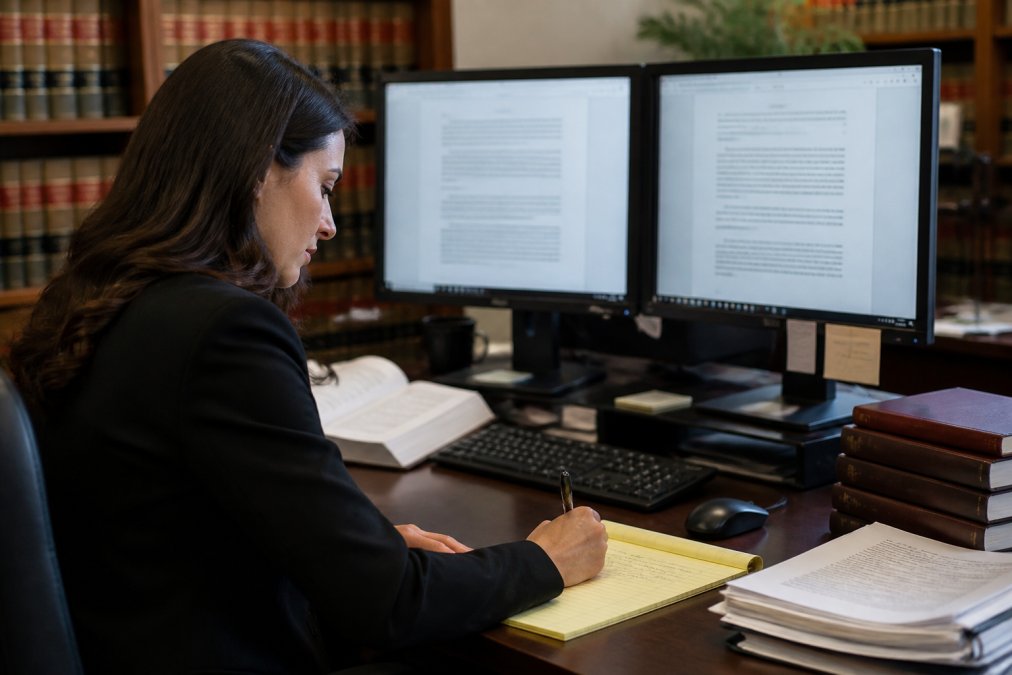
The most successful transitions happen when firms clearly identify which tasks create the biggest time drain: document assembly, client communication, case status tracking, and intake processing. Virtual paralegals work best for specific tasks and workflows. A solo practitioner might need someone handling all intake and initial document prep. A litigation team might need dedicated discovery management support. A transactional practice might focus on contract assembly and due diligence coordination.
Cost Savings: Reducing Overhead and Operational Expenses
Virtual paralegals eliminate costs associated with full-time employees: payroll taxes, benefits, office space, equipment, and recruitment. But which specific costs actually shrink depends on your firm size.
For a solo practitioner, the primary benefit is reducing the opportunity cost of your time, billable hours lost to administrative work. For a small firm with existing staff, virtual paralegals replace payroll expenses directly. You’re trading the cost of a local employee for remote support, which typically runs significantly lower because you’re not paying for benefits, office footprint, payroll taxes, or recruitment costs.
Cost savings are real but most dramatic for firms that have identified exactly which functions they want to outsource. Targeted outsourcing of specific workflows works; vague cost-cutting rarely does.
Scaling Your Practice: Increased Capacity Without Physical Expansion
Virtual paralegals change the fundamental economics of firm growth. Adding capacity typically means hiring local staff, which requires more office space, equipment, and management overhead. Virtual support lets you expand capacity without expanding your physical footprint.
A solo practitioner can handle more cases. A small firm can take on additional matters without renting extra space. A litigation practice can manage more discovery without a larger team in the same office. You adjust hours and focus areas based on actual caseload, not hiring cycles.
Workflow optimization improves dramatically when you have dedicated support. Instead of your best attorney spending two hours assembling a discovery response, a paralegal handles assembly while your attorney reviews and refines. Case turnaround time shrinks and client responsiveness improves. These aren’t cost savings, they’re capacity multipliers that allow your team to focus on higher-value work.
Virtual Paralegal Workflow Examples and Task Delegation
Real examples show where friction points exist, what systems enable success, and how to measure whether delegation is working.
Client intake and initial documentation. A new client contacts your firm. A virtual paralegal sends the intake questionnaire, gathers initial documents, organizes information in your practice management system, and flags missing pieces. Your attorney reviews a completed intake packet rather than chasing down information. Timeline: 24-48 hours from initial contact to ready-for-review.
This workflow requires: (1) access to your practice management system (e.g., Clio, LawLics) with pre-built intake form templates, (2) a secure client portal or email system for document collection, (3) a documented checklist of required documents by practice area, and (4) clear escalation rules for red flags requiring immediate attorney notification.
Discovery response assembly. Your firm receives a discovery request. A virtual paralegal organizes your document repository, cross-references the request against your files, assembles responsive documents, and creates a preliminary response draft with flagged items requiring attorney review. Your attorney spends 30 minutes reviewing rather than six hours assembling.
This requires: (1) a centralized document management system (e.g., NetDocuments, iManage, or cloud-based alternatives), (2) discovery request templates organized by practice area, (3) a defined review process showing which decisions require attorney sign-off, and (4) a quality assurance step where a senior paralegal or attorney spot-checks the first 2-3 responses.
Case file organization and deadline tracking. A virtual paralegal maintains your case calendar, flags approaching deadlines, organizes supporting documents in a shared system, and sends weekly status summaries. This prevents missed deadlines and keeps everyone aligned without requiring daily check-ins.
Implementation requires: (1) integration between your calendar system and practice management software, (2) a shared dashboard or weekly email report showing all upcoming deadlines, (3) a rule-based escalation system (e.g., "flag any deadline within 14 days with no draft work product"), and (4) consistent document naming and folder structure across all cases.
Contract assembly and transactional support. Virtual paralegals pull template language, assemble contracts, organize closing documents, and prepare signature packages. Your attorney reviews and negotiates final terms rather than spending time on assembly.
This requires: (1) a contract management system or template library with pre-configured conditional clauses, (2) a checklist of required closing documents by transaction type, (3) a defined workflow showing which provisions the paralegal can populate versus which require attorney input, and (4) a version control system.
Integration and onboarding. Virtual paralegals handle structural work that doesn’t require legal judgment. Delegation works when: (1) the task is clearly defined with documented steps, (2) your firm has invested in systems that make work visible and auditable, and (3) you’ve established quality checkpoints before work reaches clients.
Expect 2-4 weeks of onboarding where your virtual paralegal shadows your team, learns your workflows, gets trained on your systems, and completes practice tasks under supervision. Measure success by tracking case turnaround time, attorney utilization on billable work, error rates, and client responsiveness improvements, not just hours saved.
Virtual Paralegal Services Cost: What to Expect
Pricing varies based on experience level, specialization, and engagement model. Some firms charge by the hour for project-based work. Others offer subscription models with set monthly hours. Still others provide dedicated staff where you pay for availability rather than hours worked.
Project-based work costs more per hour but requires no long-term commitment. Subscription models offer better economics at scale but require forecasting your needs. Dedicated staff models work best with consistent, predictable demand.
Focus on what you’re actually outsourcing and how that maps to your budget. If you’re outsourcing 10 hours per week of intake work, the total monthly expense matters more than the hourly rate. If you’re building a dedicated remote team, the cost structure should include training, onboarding, and management support.
Bluebook Helpers handles staffing complexity directly. You get dedicated support with built-in continuity, if someone leaves, they’re replaced at no extra cost. This matters because the real cost of virtual staffing includes the time you spend managing inconsistent contractors or dealing with turnover.
Legal Outsourcing Best Practices for Remote Collaboration
Remote collaboration works when you establish clear systems and expectations upfront.
Define your process in writing. Document how you want tasks completed, which systems to use, what decisions require attorney review, and what the paralegal can handle independently. This prevents endless clarification conversations later.

Use shared systems for everything. Your virtual paralegal needs cloud-based access to documents, case management systems, templates, and communication tools. If you’re using email for case updates, you’ll create chaos with remote staff.
Establish clear communication rhythms. Weekly status meetings work better than daily check-ins. Async communication (written updates, recorded messages) often works better than constant chat for remote teams.
Monitor work quality without micromanagement. Spot-check completed work regularly and give feedback on quality issues. Trust builds as you see consistent output.
Start with pilot projects. Don’t outsource your entire intake process on day one. Start with one specific workflow, get comfortable with the process, then expand.
The best outsourcing relationships treat the virtual paralegal as part of your team. That means clear communication, defined workflows, and consistent feedback.
Security, Confidentiality, and Compliance Considerations
Client confidentiality and data security are non-negotiable. If you’re considering virtual paralegal support, you need to understand how your firm maintains control over sensitive information and complies with professional responsibility rules.
ABA Ethics and Remote Work Requirements. The American Bar Association Model Rules of Professional Conduct, specifically Rule 1.6 (Confidentiality of Information) and Rule 5.3 (Responsibilities Regarding Nonlawyer Assistants), establish that attorneys remain responsible for the conduct of nonlawyer assistants, including remote staff. Your firm is liable for any confidentiality breach by a virtual paralegal, regardless of location.
Outsourcing legal work to nonlawyers is permissible only when: (1) the attorney maintains direct supervision and control, (2) the nonlawyer is bound by confidentiality obligations, and (3) the client is informed that nonlawyer assistance will be used (in most jurisdictions). Some state bar associations have issued additional guidance requiring remote work arrangements to include the same security protections as in-office work.
Before engaging any virtual paralegal service, verify that they can provide: (1) written confidentiality agreements binding the paralegal to the same ethical standards as your firm’s employees, (2) documentation of their background check and vetting process, (3) proof of errors and omissions insurance, and (4) a written security policy you can review.
Technical Security Controls. How does your virtual paralegal access client documents? What encryption protects that access? How do you ensure documents aren’t copied or shared? What happens to data if the relationship ends?
Reputable virtual paralegal services implement: (1) encrypted file access using TLS 1.2 or higher for data in transit and AES-256 encryption for data at rest, (2) role-based access controls so a paralegal can only see documents assigned to their cases, (3) audit trails logging every document accessed, by whom, when, and what action was taken (retained for 3-5 years), (4) multi-factor authentication requiring a password plus a second verification method, and (5) automatic session timeouts after 30 minutes of inactivity.
Ask your potential provider: Do they use a secure VPN or direct encrypted connection? Can they provide an audit log showing access history? Do they support your practice management system’s native security features? If they can’t answer these questions with specifics, they’re not ready for sensitive client work.
Data Retention and Deletion. When the relationship ends, what happens to client files? A compliant provider will: (1) provide written confirmation that all client documents have been deleted from their systems within 30 days, (2) certify in writing that backups containing client data have been purged, and (3) maintain a written record of deletion.
Your engagement agreement should explicitly state data retention and deletion obligations.
Compliance by Practice Area. Some practices face additional regulatory requirements. If you handle HIPAA-regulated information, your virtual paralegal service must be a Business Associate under HIPAA and sign a Business Associate Agreement. Financial information may require Gramm-Leach-Bliley Act compliance. Litigation involving trade secrets may require security clearances. Before outsourcing work in any regulated practice area, consult your state bar association’s ethics hotline or your malpractice insurance carrier.
Vetting Your Provider. Before outsourcing any client work, conduct due diligence: (1) request references from law firms of similar size and practice area, (2) ask for a copy of their security policy and have your IT person review it, (3) verify they carry errors and omissions insurance with a minimum of $1 million coverage, (4) confirm they have a written incident response plan, and (5) require a Service Level Agreement specifying uptime guarantees, response times for security incidents, and remedies if they fail to meet obligations.
Don’t rely on verbal assurances. If a provider can’t provide written documentation of their security practices, compliance certifications, and insurance coverage, they’re not suitable for handling client confidential information.
Your Firm’s Responsibility. Even with a compliant provider, your firm remains responsible for: (1) vetting which documents and information the virtual paralegal can access, (2) maintaining audit logs of their access, (3) conducting spot checks of their work for quality and compliance, (4) immediately revoking access if the relationship ends or if you suspect unauthorized activity, and (5) notifying your malpractice insurance carrier that you’re using remote support.
The best outsourcing relationships treat security as a shared responsibility. Your virtual paralegal service provider handles the technical infrastructure; your firm maintains oversight and control.
Frequently Asked Questions
What specific tasks can a virtual paralegal handle?
Virtual paralegals manage client intake, document preparation, legal research, case file organization, scheduling, billing support, and administrative work. Many handle contract review, deposition summaries, and litigation support. The scope depends on their training and your firm's needs. Bluebook Helpers staff receive hands-on training tailored to your firm's specific software and workflows, ensuring they can handle tasks immediately without requiring you to rebuild your processes.
How much can virtual paralegal services cost compared to hiring locally?
Virtual paralegal services typically cost 70% less than hiring local, full-time staff, allowing firms to reduce overhead significantly. Costs vary based on experience level, hours needed, and complexity of work. Rather than fixed salary, benefits, payroll taxes, and office overhead, you pay for the actual support you use. For current pricing and to understand what your specific situation would cost, visit Bluebook Helpers' pricing page or schedule a consultation to get a quote tailored to your firm's needs.
Are there security concerns with using virtual paralegal services?
Data security and confidentiality are legitimate concerns in legal work. Reputable virtual paralegal providers implement strict vetting processes, confidentiality agreements, secure file transfer protocols, and ongoing performance monitoring. Your virtual support should never access client documents without encryption, clear authorization, and documented compliance procedures. Before hiring, confirm the provider's security protocols, staff background checks, and whether they maintain compliance with relevant professional standards. Ask about their data handling procedures and how they protect privileged communications.
Is it cost-effective for solo practitioners to hire virtual paralegals?
Yes, virtual paralegals are particularly valuable for solo practitioners. Rather than hiring a full-time assistant (which includes salary, benefits, taxes, and office space), you access skilled support on-demand. This lets you focus on client work and billable hours while outsourcing intake, document prep, and administrative tasks. Many solo practitioners use virtual support to scale capacity without the overhead of a permanent hire, making it a practical way to grow without significantly increasing costs.

