

Table of Contents
- What Is Legal Process Outsourcing (LPO)?
- Top Legal Outsourcing Companies for Law Firms: Quick Comparison
- 1. Bluebook Helpers: Dedicated Virtual Staffing at 70% Cost Savings
- 2. Axiom Law: On-Demand Legal Talent for High-End Projects
- 3. Integreon: Global Coverage with ISO-Certified Security
- 4. UnitedLex: Enterprise-Scale Managed Legal Services
- 5. QuisLex: Technology-Enabled Document Review & M&A Support
- 6. Wishup: Affordable Virtual Assistants for Administrative Tasks
Best Legal Outsourcing Companies for Law Firms
Last Updated: July 12, 2026
Law firms that delegate non-core work to specialized legal outsourcing companies report operational efficiency gains of 30-40% within the first six months. The market for legal process outsourcing has matured significantly, and the quality of service providers has become the primary differentiator. This guide examines the top legal outsourcing companies for law firms, breaking down what each excels at and how to match the right provider to your firm’s specific needs.
The landscape has changed dramatically. Five years ago, outsourcing legal work meant accepting offshore delays and quality trade-offs. Today, the best legal outsourcing companies operate with the same speed and precision as in-house teams, often at 40-70% lower cost.
What Is Legal Process Outsourcing (LPO)?
Legal Process Outsourcing is the delegation of specific legal tasks, document review, legal research, contract drafting, litigation support, and administrative work, to specialized external providers. Unlike hiring permanent staff, LPO gives you access to vetted legal professionals on a flexible, project-by-project or ongoing basis.
The key difference between legal outsourcing companies and traditional staffing is control and accountability. LPO providers manage recruitment, training, quality assurance, and compliance on your behalf. You contract with the organization managing staff, not the individuals themselves. This removes the HR burden while maintaining professional standards and confidentiality under formal service agreements.
LPO covers several distinct service models:
- Document Review & eDiscovery: Reviewing large volumes of documents for relevance, privilege, and responsiveness in litigation
- Contract Lifecycle Management: Drafting, reviewing, and managing contracts across multiple jurisdictions
- Legal Research & Writing: Conducting case law research, memo writing, and brief preparation
- Litigation Support: Managing discovery, organizing evidence, and coordinating witness communications
- Back-Office Administration: Intake processing, billing, scheduling, and case management
- Paralegal Services: General legal support including document preparation, filing, and client communication
Reputable legal outsourcing companies operate under ABA Model Rules compliance, maintain attorney-client privilege protections, and carry appropriate insurance and security certifications.
The best LPO providers become extensions of your team. Look for firms that invest in training on your specific practice areas and integrate with your practice management software from day one.
Top Legal Outsourcing Companies for Law Firms: Quick Comparison
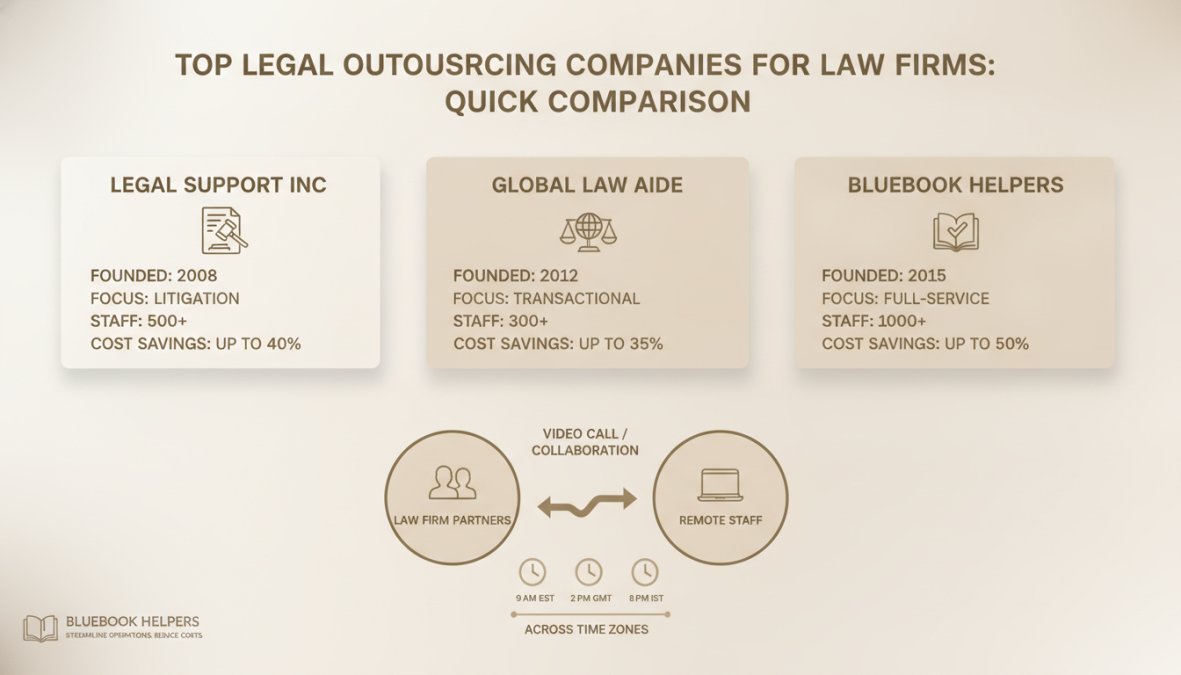
| Provider | Best For | Service Model | Key Strength | Time Zone Coverage |
|---|---|---|---|---|
| Bluebook Helpers | Cost-conscious firms under 50 attorneys | Dedicated virtual staff | 70% cost savings vs. local hire | 24/7 availability |
| Axiom Law | High-end projects & overflow | On-demand attorneys | Partner-level talent at associate rates | Global coverage |
| Integreon | Complex, regulated matters | Hybrid onshore/offshore | ISO 27001 security, Six Sigma QC | 14 countries |
| UnitedLex | Enterprise firms & corporations | Managed legal services | AI-driven contract management | Follow-the-sun model |
| QuisLex | Large-scale M&A & litigation | Technology-enabled review | Advanced TAR capabilities | Global operations |
| Wishup | Small to mid-market firms | Virtual assistants | Transparent monthly pricing | On-demand scaling |
1. Bluebook Helpers: Dedicated Virtual Staffing at 70% Cost Savings
Bluebook Helpers assigns you permanent team members trained on your firm’s specific tools and workflows. Staff cost 70% less than local equivalents but work 24/7 across your time zones. Your New York team closes files at 6 PM; your Bluebook Helpers paralegal in a different zone picks up immediately, completing overnight work for 9 AM delivery. This follow-the-sun model compounds productivity gains over weeks and months.
The firm handles recruitment, onboarding, payroll, and benefits management. You don’t deal with visa sponsorship, tax withholding, or HR compliance. Training is tailored to your firm-specific software. If performance issues arise, Bluebook Helpers replaces staff at no extra cost.
Pros:
- 70% cost savings vs. local staff
- 24/7 availability across multiple time zones
- Hands-on training tailored to your firm’s software
- Staff replacement at no extra cost if issues arise
- Seamless integration with practice management systems
Cons:
- Requires upfront investment in training and process documentation
- Best suited for firms with repeatable, documented workflows
Best For: Law firms under 50 attorneys looking to reduce overhead by 50% while scaling capacity, especially those handling high-volume document review, contract management, or administrative intake.
2. Axiom Law: On-Demand Legal Talent for High-End Projects
Axiom Law provides vetted, experienced attorneys on flexible engagements, hourly, daily, weekly, or project-based. You’re accessing lawyers with 8-15 years of BigLaw experience who now work flexibly. You pay premium rates relative to offshore LPO, but you’re getting partner-level expertise at associate-level pricing.
The flexibility is genuine. Need someone for three weeks on a specific litigation task? Done. Need ongoing contract review support? They can staff that. The model works for firms with unpredictable demand spikes or needing specific expertise they lack in-house.
Pros:
- High-quality, experienced legal talent (8-15 years average)
- Flexible engagement models (hourly, project, weekly)
- Quick turnaround for staffing requests
- Broad practice area coverage
Cons:
- Premium pricing compared to offshore-only providers
- Best for episodic needs rather than permanent capacity building
Best For: Mid-sized to large law firms needing temporary, high-level legal talent for overflow or specialized projects.
3. Integreon: Global Coverage with ISO-Certified Security
Integreon operates across 14 countries, combining onshore and offshore resources to balance cost with time zone alignment and quality control. They use Six Sigma-based quality oversight, meaning every deliverable goes through documented QC processes. For firms handling regulated matters, healthcare law, compliance, or financial services, this rigor matters. ISO 27001 and SOC 2 certifications ensure enterprise-grade security standards.
The hybrid model works well for complex matters. U.S.-based senior staff manage strategy while offshore teams handle document review and research, blending cost efficiency with local expertise where it counts.
Pros:
- Rigorous quality control processes (Six Sigma methodology)
- High-level security certifications (ISO 27001, SOC 2)
- Hybrid onshore-offshore model for balanced delivery
- Specialized expertise in regulated industries
- 24/7 coverage across 14 countries
Cons:
- Complex onboarding for highly customized workflows
- Pricing requires custom quotes
- May be overkill for straightforward matters
Best For: Large law firms and corporate legal departments handling complex, regulated matters where security and quality assurance are non-negotiable.
4. UnitedLex: Enterprise-Scale Managed Legal Services
UnitedLex operates at the enterprise end, handling entire practice areas or workflows end-to-end. Their differentiation is technology: AI-driven contract lifecycle management (CLM) platforms, eDiscovery tools, and workflow automation. They don’t just provide staff; they bring systems and process optimization, particularly valuable for corporations with in-house legal departments and large firms handling high-volume transactional work.
The "follow-the-sun" service delivery model moves work continuously across global centers, compressing timelines significantly.
Pros:
- Enterprise-scale capability and infrastructure
- Advanced AI-driven contract management and eDiscovery
- Deep expertise in complex, high-volume transactions
- Global follow-the-sun service delivery
Cons:
- Cost-prohibitive for smaller boutique firms
- Requires significant upfront investment and change management
Best For: Large law firms and Fortune 500 corporate legal departments requiring enterprise-scale support and digital transformation.
5. QuisLex: Technology-Enabled Document Review & M&A Support
QuisLex specializes in complex document review, M&A diligence, and contract management for high-stakes matters. Their competitive edge is technology-assisted review (TAR), which uses machine learning to categorize documents at scale with human oversight. For litigation involving millions of documents or M&A due diligence with tight timelines, TAR cuts review time dramatically while maintaining quality standards required for regulated industries.
Pros:
- Proven expertise in high-end, complex legal work
- Advanced technology-assisted review (TAR) capabilities
- Industry-leading security standards (ISO, SOC)
- Strong emphasis on process innovation
Cons:
- Less focused on routine administrative tasks
- Premium pricing for sophisticated technology and expertise
Best For: Firms handling complex, high-stakes litigation or large-scale M&A due diligence where technology-enabled efficiency and security are critical.
QuisLex is not the right fit if your primary need is ongoing paralegal support or routine administrative work. Their technology and expertise are built for high-complexity matters where the ROI justifies premium pricing.
6. Wishup: Affordable Virtual Assistants for Administrative Tasks
Wishup focuses on recruiting and vetting virtual assistants who specialize in legal administrative work: intake, billing, scheduling, document organization, and client communication. Pricing is transparent and predictable with flat monthly fees. The vetting process is rigorous (top 0.1% of candidates), and Wishup guarantees rapid replacement if a team member doesn’t work out. Onboarding is fast; you get a productive assistant within days.
Wishup assistants are not lawyers and not suited for substantive legal work. They excel at intake processing, calendar management, billing follow-up, and general office administration.
Pros:
- Predictable, transparent monthly pricing
- Rigorous vetting process (top 0.1% of candidates)
- Fast onboarding and rapid replacement guarantee
- Easy to scale support up or down
Cons:
- Not suitable for complex, substantive legal research or drafting
- Limited to administrative and paralegal support
Best For: Solo practitioners and small to mid-sized law firms needing reliable administrative support without the overhead of hiring local staff.
How to Choose a Legal Outsourcing Provider
Selecting the right legal outsourcing provider requires matching your firm’s specific needs to the provider’s strengths. Start by defining what you’re outsourcing. Is it high-volume, repetitive work (document review, intake processing) or episodic, specialized projects (M&A due diligence, complex litigation)? Dedicated staffing works for ongoing volume; on-demand talent works for episodic needs.
Next, evaluate security and compliance. All reputable providers maintain attorney-client privilege protections and comply with ABA Model Rules. If you handle regulated industries (healthcare, financial services, government contracts), ISO 27001 and SOC 2 certifications matter. For small firms handling standard commercial work, this level of certification is unnecessary overhead.
Assess integration capability. Does the provider integrate with your practice management software? Can they import your templates and workflows? Integration directly impacts productivity gains.
Finally, evaluate the vendor relationship. Will you have a dedicated account manager? Can you escalate issues quickly? The best legal outsourcing companies treat you as a partner, not a transaction.
The cheapest provider isn’t always the best value. A provider that costs 20% more but integrates seamlessly with your systems and delivers higher quality often saves you money overall through reduced rework and faster turnaround.
Risk Management and Data Security
Outsourcing legal work introduces data security risks that must be actively managed. Verify that the provider maintains attorney-client privilege protections and has confidentiality agreements (NDAs) in place with staff. Ask about data encryption practices, both in transit and at rest. Email is a significant vulnerability; confirm they use secure file transfer.
If you handle regulated matters, confirm the provider understands specific compliance requirements. Verify the provider carries professional liability insurance and confirm coverage limits. Establish audit rights in your contract so you can periodically audit the provider’s security practices, access controls, and staff training.
Cost Savings and Operational Efficiency
The financial case for legal outsourcing is straightforward: you reduce per-hour costs while increasing capacity. A paralegal in the U.S. costs $60-90K annually plus benefits; the equivalent from a reputable outsourcing provider costs $18-35K. That’s 50-70% savings on labor.
The real efficiency gain is velocity. Dedicated staff working across time zones compress timelines significantly. Work that would take your team three days takes one day. Clients get faster turnaround. You can handle more matters with the same senior staff.
The payoff timeline depends on firm size and outsourcing volume. A solo practitioner outsourcing 10 hours weekly of administrative work might save $500-800 monthly. A 20-attorney firm outsourcing document review and intake might save $15,000-25,000 monthly. Most firms recoup implementation costs within 2-3 months of full operation.
Industry Trends in Legal Outsourcing
The legal outsourcing market has shifted significantly. Five years ago, outsourcing meant accepting lower quality. Today, the best providers deliver quality equal to in-house teams. This has fundamentally changed how firms think about capacity.
Hybrid models are accelerating. Rather than choosing between "all in-house" or "all outsourced," firms are building hybrid teams. Senior attorneys handle client relationships and strategy; outsourced staff handle execution and volume work.
AI integration is becoming standard. Providers are embedding machine learning into document review, contract analysis, and legal research. This doesn’t replace humans; it amplifies them. Lawyers focus on judgment; algorithms handle pattern recognition at scale.
Remote work has normalized outsourced staffing. The stigma has evaporated, and the regulatory environment is stabilizing. The ABA has clarified that outsourcing is permissible under Model Rules 5.1 and 5.3, provided proper supervision and confidentiality protections are maintained.
Choosing among legal outsourcing companies ultimately comes down to matching your firm’s specific workflow, security requirements, and growth stage to the right provider. Bluebook Helpers excels at providing dedicated virtual staff trained on your firm’s exact processes, delivering 70% cost savings while maintaining 24/7 availability and seamless integration with your existing systems. The firm handles recruitment, training, and performance management entirely, so you focus on client work, not HR overhead. Book a consultation with Bluebook Helpers to discuss your firm’s specific needs and explore how dedicated virtual staffing can accelerate your growth.
Frequently Asked Questions
What is legal process outsourcing (LPO) and how does it work?
Legal process outsourcing (LPO) is the delegation of legal tasks and operations to external service providers, either onshore, nearshore, or offshore. LPO firms handle document review, eDiscovery, contract lifecycle management, legal research, paralegal support, and back-office functions. Firms maintain oversight while outsourced providers manage staffing, training, and performance. This model allows law firms to scale capacity without hiring permanent employees, reducing overhead by up to 50% while maintaining quality and compliance with ABA Model Rules.
How much can law firms save by using legal outsourcing companies?
Cost savings depend on the type of work outsourced and the provider model. Dedicated virtual staff typically cost 70% less than local hires for equivalent roles. Administrative outsourcing can reduce overhead by 30-50%, while project-based services like document review offer variable cost structures tied to volume. Firms should evaluate total cost of ownership, including training, integration, and management time, rather than hourly rates alone. Transparent pricing models help firms predict and control expenses.
What are the main risks of legal outsourcing, and how can firms mitigate them?
Key risks include data security breaches, loss of attorney-client privilege, compliance violations, and quality inconsistencies. Mitigation strategies include: vetting providers for ISO 27001/SOC 2 certifications, requiring confidentiality agreements, ensuring vendor compliance with ABA Model Rules, implementing secure file transfer protocols, conducting regular audits, and maintaining clear communication channels. Firms should also establish performance metrics, use dedicated teams rather than shared resources for sensitive work, and retain substantive legal work in-house. A robust security and ethics checklist helps identify provider gaps before engagement.
How do I choose the right legal outsourcing company for my firm?
Evaluate providers using these criteria: practice area expertise (litigation, contracts, compliance), security certifications (ISO 27001, SOC 2), staffing model (on-demand vs. dedicated), pricing transparency, integration capabilities with your practice management software, time zone alignment, and track record with similar-sized firms. Request references, conduct security audits, and test onboarding with a pilot project. Assess whether you need temporary overflow support (Axiom Law) or long-term integrated teams (NeoWork). Compare pricing models, flat-fee subscriptions offer predictability, while project-based pricing suits variable workloads.
Should law firms outsource to AI-powered services or human staff?
The choice depends on task complexity. AI excels at high-volume, repetitive tasks like document classification, contract extraction, and initial eDiscovery filtering, reducing review time and costs. Human staff are essential for nuanced work: legal analysis, client communication, strategy, and sensitive matters requiring judgment. Many leading providers combine both: AI handles initial triage, humans perform substantive review. Firms should use AI for efficiency gains while keeping experienced paralegals and attorneys for complex work. Hybrid models maximize cost savings without sacrificing quality or compliance.

