

Table of Contents
- Why Small Firms Are Moving Beyond LegalSoft
- Practice Management Software Alternatives to LegalSoft
- Virtual Legal Assistant Pricing for Small Firms
- How to Manage Virtual Legal Assistants for Maximum Efficiency
- Hybrid Approach: Software Plus Staffing
- Total Cost of Ownership: Software vs. Virtual Staffing
- Security, Compliance, and Data Protection Standards
- Which Alternative Is Right for Your Firm?
Last Updated: August 5, 2026
Why Small Firms Are Moving Beyond LegalSoft
Small law firms face a choice: invest in another practice management platform or rethink how they staff their operations entirely. The software-first approach has dominated for years, but it’s running into real limits for solo practitioners and small teams.
Platforms like LegalSoft organize cases, track time, and generate invoices, but they don’t answer calls, intake clients, prepare documents, or manage the administrative work that consumes most of your day. A legalsoft alternative for small firms needs to address what software can’t: the people work. Many small firms now combine practice management tools with virtual staffing solutions. A full-time local paralegal costs $45,000-$60,000 annually plus benefits. A trained virtual legal assistant costs significantly less while offering flexibility and built-in management.
This guide covers the full landscape of alternatives, both software platforms and staffing models, so you can build the right operational foundation for your firm.
Practice Management Software Alternatives to LegalSoft
If you’re staying in the software-only lane, several platforms offer stronger feature sets for small firms than LegalSoft. Each solves different pain points.
Clio Manage
Clio Manage handles the full practice lifecycle in one place: case management, time tracking, billing with IOLTA compliance, document management, and a client portal. The platform connects to over 250 third-party applications, which matters if you’re using specialized tools for accounting or document automation.
Pricing starts at $49 per user per month. Clio’s real strength is its ecosystem, bar associations approve it, and integrations are abundant. If you need a platform that talks to everything else in your tech stack, Clio is the safest choice.
MyCase
MyCase occupies the middle ground between simplicity and power. It’s easier to set up than Clio and includes more automation than some competitors. The client portal is strong, clients can message you, upload documents, and check case status without a separate login.
Starting at $49 per user per month, MyCase costs the same as Clio but with fewer integrations. That trade-off makes sense for small firms that don’t need to connect to a dozen other tools. The platform’s strength is usability.
PracticePanther
PracticePanther positions itself as the easiest-to-use all-in-one platform. The interface is modern, setup is fast, and automation features like Zapier integration give you flexibility without technical overhead. Time tracking, billing, trust accounting, and document management work together intuitively.
At $49 per user per month, PracticePanther includes more automation features in every tier than competitors. The limitation emerges on complex litigation cases with heavy reporting requirements.
SimpleLaw
SimpleLaw is the affordable option, offering a free tier and paid plans at $39 per user per month. The platform includes case tracking, time tracking, billing, and a client portal, the essentials without bloat.
The trade-off is integrations. SimpleLaw connects to fewer tools than Clio, but for a firm using just practice management software plus basic accounting, that limitation barely matters.
| Platform | Starting Price | Best For | Key Strength |
|---|---|---|---|
| Clio Manage | $49/user/month | Firms needing extensive integrations | Ecosystem and bar association approval |
| MyCase | $49/user/month | Practices prioritizing ease of use | Intuitive client portal |
| PracticePanther | $49/user/month | Firms wanting automation without complexity | Automation features in every tier |
| SimpleLaw | $39/user/month | Budget-conscious solo practices | Lowest cost with core features |
Virtual Legal Assistant Pricing for Small Firms
Virtual legal assistant pricing for small firms typically ranges based on whether you need part-time or full-time coverage, whether the assistant handles intake and client communication or back-office work, and what software training they require. Most vendors charge either hourly rates for flexible staffing or monthly packages for dedicated staff.
The advantage of virtual staffing is predictability. You know your monthly cost upfront. You don’t pay for benefits, payroll taxes, or office space. You also don’t manage hiring, onboarding, or termination, the vendor handles that.
Bluebook Helpers provides trained virtual legal staff with hands-on onboarding specific to your firm’s software and workflows. Staff cost 70% less than local equivalents, creating immediate overhead savings. The vendor manages performance, attendance, and replacement if issues arise.
How to Manage Virtual Legal Assistants for Maximum Efficiency
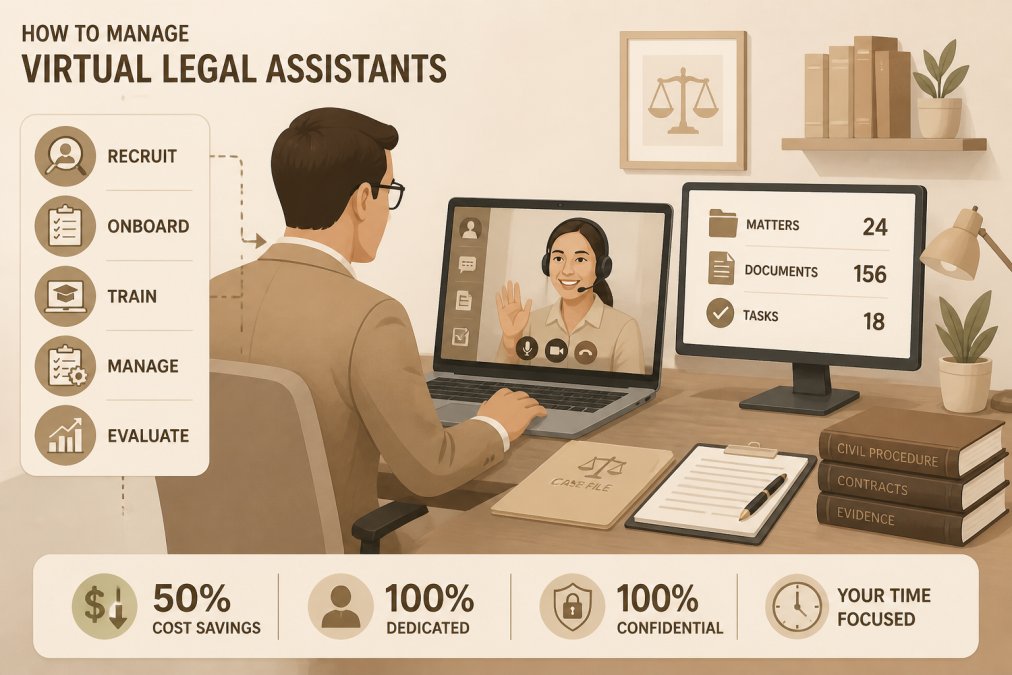
(/benefits-of-virtual-legal-assistants/) for Maximum Efficiency]
Bringing in a virtual assistant only works if you use them effectively. The biggest mistake small firm owners make is treating virtual staff like contractors they can hand tasks to sporadically.
Effective management starts with clarity. Document your processes before the assistant arrives: your intake workflow, how you want documents organized, and what software they need to know. Set clear expectations for availability and communication. If you need someone available 9 AM to 5 PM your time zone, say it.
Use asynchronous communication tools, Slack, email, or your practice management software, as the primary channel. Video calls should be scheduled for complex issues or training, not daily check-ins. Monitor output, not activity. You don’t need to watch them work; you need to see that intake forms are completed accurately and deadlines aren’t missed.
Schedule weekly check-ins, not daily ones. A 15-minute call to review the week’s work and clarify priorities is enough. Most importantly, give them real work. Virtual assistants are most effective when they handle meaningful tasks like client intake and document preparation, not busywork.
Hybrid Approach: Software Plus Staffing
The smartest small firms aren’t choosing between software and staffing. They’re combining both.
You use a practice management platform like Clio or PracticePanther to organize cases, track time, and generate invoices. You hire a virtual legal assistant to handle intake calls, prepare initial documents, organize files, and manage administrative deadlines. The software provides structure and automation. The assistant provides the human touch and handles work that software can’t.
This hybrid model is more efficient than either approach alone. For a firm doing $300,000-$500,000 in annual revenue, the hybrid approach typically costs less than 15% of revenue while freeing up your time to focus on client work and business development.
Total Cost of Ownership: Software vs. Virtual Staffing

When comparing alternatives, don’t just look at line-item cost. Total cost of ownership includes hidden expenses.
Software-only approach:
- Platform subscription: $49-$109 per user per month
- Implementation and training: 20-40 hours of your time (valued at $200-$300/hour)
- Integration with accounting software: additional subscription or manual time
- Automation tools and add-ons: $50-$200 per month
For a solo practice with one staff member, that’s roughly $1,500-$2,500 annually in software costs plus 40-80 hours of your time. At a loaded hourly rate of $250, that’s another $10,000-$20,000 in hidden cost.
- Monthly staffing cost: varies by vendor and hours
- Onboarding and training: typically handled by the vendor
- Payroll and benefits: included in the vendor’s cost
- Performance management: handled by the vendor
The hybrid approach:
- Software subscription: $1,500-$2,500 annually
- Virtual assistant: pricing depends on quantity, dates, and delivery. Visit the Bluebook Helpers website for current prices or a quote.
- Implementation: 10-20 hours of your time
For a firm with $300,000-$400,000 in annual revenue, a hybrid setup typically costs $30,000-$50,000 annually, 7-12% of revenue. A local office manager would cost $45,000-$65,000 plus benefits and payroll taxes, bringing total cost to $55,000-$80,000. The hybrid approach saves 30-40%.
Security, Compliance, and Data Protection Standards
Reputable staffing vendors implement security standards that often exceed what small firms have in place locally. Look for vendors that meet these standards:
Data encryption: All communication and file storage should use industry-standard encryption (TLS for transmission, AES-256 for storage).
Background vetting: The vendor should conduct criminal background checks and verify credentials.
Confidentiality agreements: Virtual staff should sign non-disclosure agreements and be trained on attorney-client privilege.
Access controls: The vendor should limit staff access to only the files and systems they need.
Compliance training: Staff should be trained on state bar confidentiality rules and your firm’s security protocols.
Audit trails: Your practice management software should log who accessed what files and when.
When evaluating a vendor like Bluebook Helpers, ask about their specific security protocols, vetting process, encryption, and professional liability insurance. The best vendors are transparent about security.
Which Alternative Is Right for Your Firm?
Choosing between software-only, staffing-only, and hybrid approaches depends on your practice size, practice area, and growth plans.
Choose software-only if:
- You’re a true solo with minimal administrative work
- You have a part-time assistant who handles most admin tasks
- You’re on a tight budget and can’t afford staffing
Clio Manage or PracticePanther work well for this path.
Choose staffing-only if:
- You’re drowning in administrative work but can’t afford expensive software
- Your practice is heavily intake-driven (personal injury, family law, immigration)
- You need 24/7 coverage for client communication
A vendor like Bluebook Helpers provides trained legal staff and handles software training.
Choose hybrid if:
- You’re growing and need to increase capacity without hiring locally
- You want both operational structure (software) and human flexibility (staff)
- You can afford $30,000-$50,000 annually for combined costs
Most growing small firms end up here. The hybrid approach scales better than either approach alone.
Start with your biggest pain point. If it’s case disorganization and billing, software is your priority. If it’s client communication and intake bottlenecks, staffing solves that faster. If it’s both, go hybrid.
The landscape of practice management has shifted. You no longer have to choose between expensive local hiring and hoping software solves everything. Virtual staffing vendors and modern practice management platforms give you options that didn’t exist five years ago.
Bluebook Helpers specializes in connecting small firms with trained virtual legal staff who handle intake, document preparation, and administrative work. With staff costing 70% less than local equivalents, 24/7 availability, and hands-on training tailored to your firm’s software, you get the staffing benefits without the overhead burden. Book a consultation to explore how a hybrid staffing and software approach could work for your firm.
Frequently Asked Questions
What are the main differences between a legalsoft alternative and virtual staffing for small law firms?
Practice management software automates workflows, billing, and document storage but requires your team to operate it. Virtual legal assistant staffing adds human capacity to handle intake, client communication, and administrative work. Small firms often benefit from both: software handles case organization while virtual staff handle the tasks that software can't complete, client outreach, document preparation, and intake management. The choice depends on your bottleneck: if you lack time, virtual staffing helps; if you lack organization, software helps.
How much can virtual legal assistant pricing for small firms actually save compared to hiring locally?
Virtual legal assistant staffing typically costs 30-50% less than hiring local paralegals or administrative staff, depending on experience level and scope of work. The savings come from lower salary expectations in remote markets, no office space overhead, and simplified payroll management. However, pricing varies based on role complexity, hours required, and whether you need specialized expertise in litigation or transactional work. Request a pricing consultation to see actual figures for your firm's needs.
What happens if the virtual legal assistant assigned to my firm doesn't work out?
Reputable virtual staffing providers offer replacement guarantees at no additional cost. This means if performance, communication, or fit issues arise, the vendor sources and onboards a replacement without charging extra fees or requiring you to restart a recruitment process. Look for vendors that include this in their service model and clarify the timeline for replacement, most can transition a new person within 1-2 weeks. This protects you from the disruption of losing support mid-case.
How do I actually monitor a virtual legal assistant working remotely to ensure quality and confidentiality?
Effective oversight includes regular check-ins via video call, screen-sharing during complex tasks, and clear documentation of workflows and quality standards. Most virtual staffing vendors provide performance monitoring tools and handle background vetting and confidentiality training on your behalf. Start with a trial period to establish communication patterns and confirm the assistant understands your firm's intake process, document naming conventions, and security protocols. Clear expectations upfront prevent most management issues.
Can virtual legal assistants handle complex transactional work, or are they limited to document prep and intake?
It depends on the staffing vendor and the specific assistant's experience. Some virtual legal assistants have paralegal certifications and litigation or transactional experience and can assist with contract review, due diligence support, and legal research. Others focus on administrative tasks like intake and scheduling. When evaluating vendors, ask about staff qualifications, training programs, and whether they can match you with someone experienced in your practice area. Vendors that specialize in legal staffing (not general administrative outsourcing) are more likely to have staff capable of substantive legal work.

